

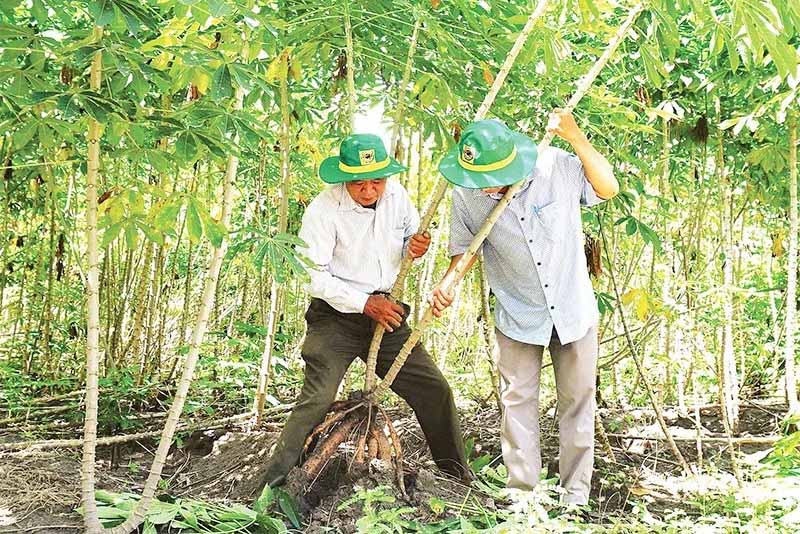
The cassava industry in Tay Ninh is moving towards sustainable development.
To ensure that farmers in Tay Ninh can confidently develop cassava (tapioca) cultivation, moving towards sustainable development, creating jobs and increasing income for each farming household, and contributing to foreign exchange earnings for the province, the agricultural sector is working alongside farmers through scientific and technical solutions.
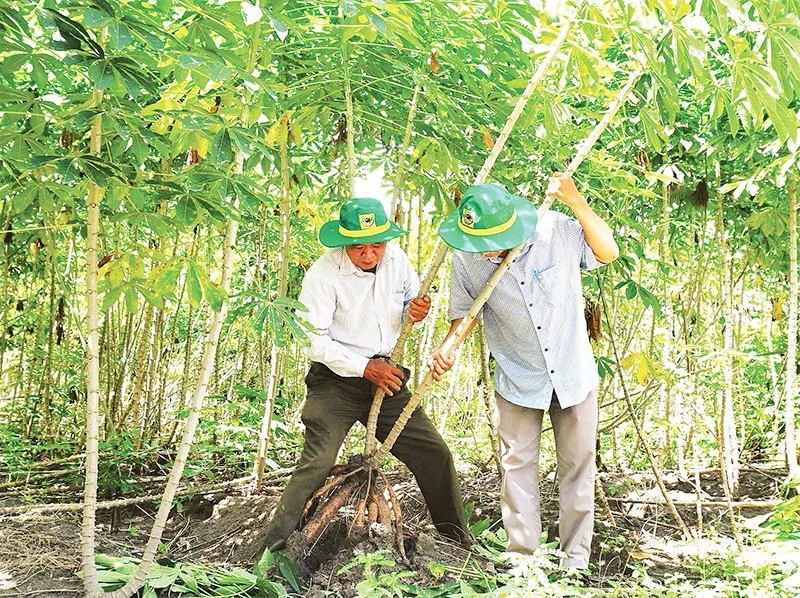
Agricultural extension officers inspect the growth process of cassava plants. At the same time, the industry is also developing model projects nationwide in the cultivation, care, and processing of cassava starch for export.
Tay Ninh has the second largest cassava cultivation area in the country, with approximately 59,000-62,000 hectares. Cassava is grown mainly in border communes such as Tan Phu, Tan Chau, Tan Hoi, Tan Dong, Thanh Binh, Tra Vong, Tan Lap, Loc Ninh, Cau Khoi, Duong Minh Chau, Ninh Dien, Phuoc Vinh, Hao Duoc, etc. Cassava is currently a key crop, ranking third in terms of cultivation area after rice and rubber. Each year, Tay Ninh farmers harvest more than 2 million tons of cassava, with an average yield of over 330 tons/ha, the highest in the country.
To ensure stable cassava cultivation, high profits for growers, and stable employment for workers, Tay Ninh province has attracted more than 65 businesses to invest in cassava starch processing plants, with a processing capacity of hundreds of tons per day. This strong investment in the cassava industry has helped to keep cassava prices fluctuating between 2,100 and 2,500 VND/kg in 2025, generating nearly 1 billion USD in export revenue from cassava starch.
Mr. Nguyen Dinh Xuan, Deputy Director of the Department of Agriculture and Environment of Tay Ninh province, said that in the period 2023-2025, cassava cultivation in Tay Ninh developed favorably in both area and yield, but the production was still insufficient to meet the processing needs of starch factories in the province. Tay Ninh is a locality with a large capacity for cassava starch production and processing in the country, with many enterprises capable of deep processing to serve domestic production and export. To stabilize the cassava raw material for factories, in 2025, the Tay Ninh Cassava Starch Producers Association and the Cambodian Cassava Federation and partners agreed to sign a memorandum of understanding to import 9 million tons of fresh cassava annually, worth approximately 1 billion USD, for processing and export. This is not just a number, but a commitment from the local agricultural sector for the livelihoods of cassava farmers and workers, contributing to the socio-economic development of the province.
“Cassava cultivation solves employment problems, reduces poverty, increases income, and creates real prosperity because one hectare of cassava provides stable employment for one worker year-round. With a yield of 25 tons/hectare and a selling price ranging from 2,100 to 2,500 VND/kg, it’s enough to cover the living expenses of a family raising children and sending them to school. The 9 million tons that both sides have committed to is a ‘billion-dollar bridge’ connecting the two economies. Because after each truckload of cassava crosses the border, there is the sweat of the farmers, the hope of children going to school, and faith in the future. The cooperation between the two sides is not just about buying and selling raw materials, but about growing together, so that farmers can confidently invest in new varieties, so that businesses have a sustainable supply, and so that the border becomes the starting point of prosperity,” Mr. Xuan said enthusiastically.
Despite the benefits, farmers and the agricultural sector still have many concerns about cassava mosaic disease. The Tay Ninh Provincial Agricultural Extension Center reports that the agricultural sector has recently researched and developed seven cassava varieties (HN1, HN3, HN5, HN36, HN80, HN97, HLRS-15) resistant to cassava mosaic disease, which have been approved for circulation. Of these, only HN1 and HN5 are widely grown by farmers, but they are exhibiting some drawbacks such as root rot, severe tuber rot, and witches’ broom disease. Currently, there is a shortage of high-quality, disease-free cassava varieties in the province.
Furthermore, cassava processing businesses have not yet developed their own raw material areas, mainly adopting a “buy as you produce” model, which easily leads to price competition for raw materials, especially when the supply decreases. Cassava starch processing also causes environmental pollution due to the high investment costs in waste treatment. Mechanization in planting, fertilizing, and spraying only reaches 20% to 40% depending on the region; mechanization in harvesting is only about 3%, resulting in high losses, high labor costs, and lower-than-desired productivity. However, with cassava purchase prices ranging from 2,100 to 2,500 VND/kg, after deducting costs, farmers earn a profit of 33-49 million VND/ha. Modified starch, malt, sugar, sorbitol, ethanol, etc., are exported by businesses to the Chinese market, accounting for 70%.
To maintain and develop cassava production area, improve productivity, control cassava mosaic disease, and restructure starch processing towards technological innovation, Tay Ninh’s agricultural sector is continuing to apply advanced technical measures such as: using new high-quality varieties, applying fertilizer according to proper procedures, increasing the use of organic fertilizers, and water-saving irrigation; increasing mechanization in cassava planting and care; coordinating with research agencies to evaluate, select, and rapidly propagate cassava varieties resistant to cassava mosaic disease; and reorganizing production in a way that links cassava growers, businesses, and processing plants…
According to Deputy Director of the Tay Ninh Department of Agriculture and Environment, Dinh Thi Phuong Khanh, processing and manufacturing businesses need to diversify starch-based products such as modified starch, sorbitol, malt, and ethanol; ensure quality and food safety; build industry brands; promote trade; and develop long-term strategies to improve the quality and competitiveness of cassava cultivation and processing.
MINH ANH, THANH PHONG
Source: www.vietnam.vn
-
admin ttta-pioca
